
Appearance
Shuffle
How the shuffle works
A shuffle is Spark's mechanism for exchanging, sorting, grouping, and merging data across executors whenever an operation needs rows that share a key to land on the same partition. At the DataFrame/SQL level, the classic wide transformations that trigger one are groupBy(), join(), agg(), sortBy(), and reduceByKey()-style aggregations. Any join implementation that isn't a broadcast join (shuffle hash join, shuffle sort-merge join, or shuffle-and-replicated nested loop / Cartesian product join) also requires a shuffle[1]. At the RDD layer underneath, the operations that can cause a shuffle are repartitioning (repartition, coalesce), 'ByKey operations other than counting (groupByKey, reduceByKey), and join-family operations (cogroup, join)[2].
Spark can skip the shuffle outright in a few well-defined cases where it already knows the data layout. Storage Partition Join (SPJ) avoids the shuffle phase entirely when Spark can use the partitioning already reported by a compatible V2 data source (spark.sql.sources.v2.bucketing.enabled, default true since 3.3.0), generalizing bucket joins to functions registered in a FunctionCatalog[3]. Classic Hive-style bucketing gets the same effect: once both sides of a join are bucketed and sorted the same way, the physical plan shows no Exchange operator at all[4]. DataFrameWriter.partitionBy, by contrast, does not trigger a shuffle by itself on write, though it can still leave you with a large number of small output files[5].
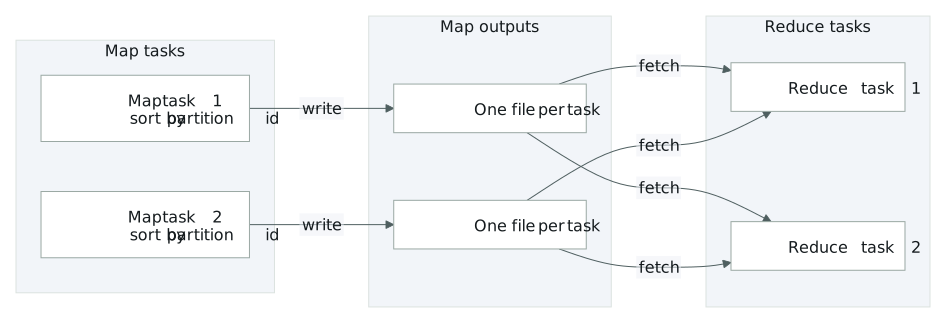
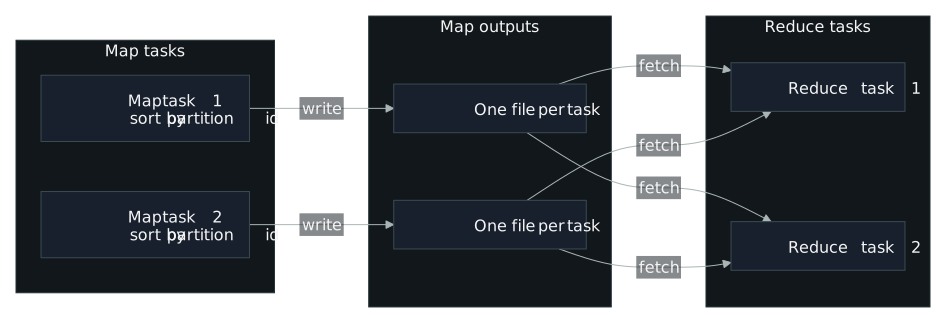
Modern Spark ships a single shuffle manager, SortShuffleManager (3.5 source). Incoming records are sorted by their target partition id and written to one map output file per task; reducers then fetch contiguous regions of that file for their share of the map output, spilling sorted subsets to disk and merging them if the data doesn't fit in memory[6]. Internally it has two write paths: a "serialized sorting" path used when there's no map-side combine, the serializer supports relocation of serialized values (Kryo or Spark SQL's custom serializers), and the shuffle produces at most 16,777,216 output partitions; and a "deserialized sorting" path used for everything else[6:1]. Framed against the older hash-based approach (where each map task produces a separate output file per reduce task rather than one sorted file), sort-based shuffle pays a sorting cost but scales better once shuffle data gets large, which is why Spark and Flink both moved to it and pair it with an external shuffle service[7].
Two pieces of supporting infrastructure sit alongside the core shuffle manager. The external shuffle service (spark.shuffle.service.enabled, default false) preserves the shuffle files written by executors so they can be safely removed, or so shuffle fetches continue even after an executor failure; enabling it requires standing up the service separately, since the flag alone isn't enough[8]. It's a long-running process on each cluster node, independent of any particular Spark application or its executors: once enabled, executors fetch shuffle files from this service instead of from each other, so shuffle state written by an executor keeps being served after that executor's own lifetime ends[9]. Push-based shuffle, designed under SPARK-30602 and based on LinkedIn's "Magnet" shuffle service, goes further: it changes the reduce side from a pull model (reducers requesting many small, randomly-ordered blocks from wherever each mapper wrote them) into a push-and-merge model, where mapper-generated blocks are pushed to remote Magnet shuffle services that opportunistically merge them into large per-partition chunks before the reduce stage starts[7:1].
Reading Exchange nodes
Whether an operation shuffles doesn't have to be guesswork: shuffles show up in the physical plan as Exchange nodes, and reading the plan is the most direct way to check. groupBy() on a DataFrame is a wide transformation and normally requires an Exchange so all rows for a key land on the same partition[1:1]; that node disappears only when Spark already knows the data is co-partitioned by the grouping key. The clearest documented case is a table bucketed and sorted on the join/group key, where the physical plan drops the Exchange because the data was already shuffled at write time[10]. SPJ produces the same absence of an Exchange for join queries against compatible V2 sources[3:1].
DataFrame.repartition(key) is worth watching for separately: it's a one-time, explicit shuffle, but if you cache the result, subsequent joins on that same key skip their own shuffle because the data is already partitioned that way[5:1]. Don't mistake partitionBy on write for the same thing: it changes the on-disk directory layout but is "not the equivalent" of an in-memory repartition, so df.groupBy('key').sum() over data written with partitionBy still requires an Exchange[5:2].
Deduplication is a case where there's no avoiding the shuffle regardless of how you write it: Spark SQL's dropDuplicates selects unique rows the same way RDD-level distinct does, and both "can require a shuffle"[11]. The only documented difference between them is key flexibility, not shuffle volume: unlike RDD distinct, DataFrame dropDuplicates can optionally drop rows based on only a subset of columns (e.g., dropDuplicates(List("id"))) rather than requiring uniqueness across the whole row[11:1].
Where the cost accumulates
Confirming a shuffle happened is the easy part; pricing it out is the harder one. Shuffle cost shows up in several places at once, and Spark's shuffle-tuning knobs largely exist to manage it. Inside SortShuffleManager, when there are fewer than spark.shuffle.sort.bypassMergeThreshold reduce partitions (default 200)[8:1] and no map-side aggregation is needed, Spark takes a bypass path: it writes numPartitions files directly per map task and concatenates them at the end, rather than merge-sorting spilled files. This avoids serializing and deserializing the data twice, which the normal merge-sort path would otherwise pay; the trade-off is having multiple files open at once, and more memory allocated to buffers[6:2]. That trade stays cheap only while the reduce-side partition count is small.
Reducers also pay a fixed memory cost for every map output fetched in parallel, since each needs a buffer to receive it; that's what spark.reducer.maxSizeInFlight (default 48m) caps[8:2]. And map tasks pay an I/O cost writing shuffle files: a larger spark.shuffle.file.buffer (default 32k) reduces the number of disk seeks and system calls needed to create those intermediate files[8:3].
External shuffle infrastructure matters most once dynamic allocation is in play: without the external shuffle service, an executor decommissioned mid-shuffle (say, because of stragglers) would force its shuffle files to be recomputed from scratch once it's removed[9:1]. Push-based shuffle exists because, as shuffle data volume grows, the number of blocks a classic shuffle produces grows quadratically (mappers × reducers) while individual block sizes shrink to only tens of KB, which is inefficient for HDD-backed random reads[7:2]. Magnet's push-and-merge model improves disk I/O efficiency by converting many small random reads into large sequential reads of pre-merged chunks, and improves reducer data locality since merged output can be co-located with the reduce tasks that consume it; the push itself is decoupled from the mappers, so it doesn't add to map task runtime or fail map tasks if a push fails, and it's best-effort, so reducers can fetch a mix of merged and unmerged blocks[7:3]. LinkedIn's own production rollout, on a cluster running 30K+ Spark applications shuffling roughly 5 PB/day, reported a large reduction in shuffle read wait time and a corresponding drop in total executor runtime after enabling it on complex production flows[7:4].
Tuning or avoiding the shuffle
The levers split into two groups: avoiding a shuffle, and tuning the one you can't avoid. Where possible, avoid the shuffle rather than tune it: bucket and sort tables on the join/group key so the physical plan drops the Exchange entirely[10:1][4:1], or lean on Storage Partition Join for compatible V2 sources[3:2]. If you need to reuse a partitioning scheme across several joins, repartition(key) once and cache the result rather than relying on partitionBy, which only affects the on-disk layout and doesn't exempt later aggregations from their own Exchange[5:3].
PySpark:
dropDuplicates(subset)still shuffles likedistinct(), but lets you dedupe on a subset of columns instead of the whole row; usedf.dropDuplicates(["id"])when uniqueness only needs to hold on a few key columns[11:2].
For shuffles you can't avoid, the main tuning levers are:
spark.shuffle.sort.bypassMergeThreshold(default 200): raise or lower the reduce-partition-count cutoff for the bypass (hash-style) write path described above[8:4].spark.shuffle.compress(defaulttrue): compresses map output files using whatever codecspark.io.compression.codecnames (defaultlz4;lzf,snappy, andzstdare also available)[8:5].spark.shuffle.spill.compress(also defaulttrue) separately governs compression of spilled shuffle data, using the same codec setting[8:6].spark.reducer.maxSizeInFlight(default 48m): raising it lets more data move in flight at the cost of per-task memory; lowering it saves memory at the cost of more fetch rounds[8:7].spark.shuffle.file.buffer(default 32k): Learning Spark's tuning guidance recommends bumping it to 1 MB for large jobs, trading some per-task memory for fewer disk seeks and syscalls during the shuffle-write phase[1:2].spark.shuffle.service.enabled(defaultfalse): turn on the external shuffle service so executors can be safely removed under dynamic allocation without losing shuffle state. Dynamic allocation's documentation lists shuffle tracking (spark.dynamicAllocation.shuffleTracking.enabled), shuffle-block decommissioning, and a customShuffleDataIOplugin backed by reliable storage as alternatives to enabling the service outright[8:8].- Push-based shuffle: enable it with the paired server/client flags added in Spark 3.2.0:
spark.shuffle.push.server.mergedShuffleFileManagerImplon the server side, andspark.shuffle.push.enabled=trueon the client side (both disabled by default; the client flag only takes effect together with the server-side one). It's currently only supported for Spark on YARN with the external shuffle service enabled[8:9].
Sources
Learning Spark, 2nd Edition, Damji, Wenig, Das, Lee, ch. 7: Optimizing and Tuning Spark Applications ↩︎ ↩︎ ↩︎
Performance Tuning: Spark SQL, DataFrames and Datasets Guide ↩︎ ↩︎ ↩︎
SPARK-30602: Support push-based shuffle to improve shuffle efficiency (Magnet) ↩︎ ↩︎ ↩︎ ↩︎ ↩︎
High Performance Spark, 2nd Edition, Karau, Polak & Warren, ch. 5: DataFrames, Datasets, and Spark SQL ↩︎ ↩︎ ↩︎