
Appearance
Task Failures
FAIL
What it is
A task failure is any task end whose Reason field is something other than success. Spark's event log serializes this as the formatted class name of whichever TaskEndReason instance was assigned to that task attempt[1], and the canonical set of reasons is Success, FetchFailed, ExceptionFailure, TaskResultLost, TaskKilled, TaskCommitDenied, ExecutorLostFailure, Resubmitted, and UnknownReason[1:1]. Each carries its own extra detail: a FetchFailed records a reduce ID and message; an ExceptionFailure carries the exception's class name, description, and stack trace, plus accumulator updates (falling back to reading them out of the task's metrics object for logs written by Spark 1.x); a TaskKilled records a kill reason; a TaskCommitDenied records the job ID, partition ID, and attempt number; an ExecutorLostFailure records whether the loss was caused by the application, the executor ID, and a loss reason; UnknownReason carries no extra fields[1:2].
How it's detected
| failed tasks (share) | Level |
|---|---|
| > 5% | Warning |
| > 20% | Critical |
The task-metrics object attached to a SparkListenerTaskEnd event is optional in the schema, so it isn't guaranteed to be present for every failure. It tends to be populated for reasons where the attempt actually ran far enough to produce metrics (an ExceptionFailure or TaskKilled, for instance) but can be absent for a Resubmitted attempt that never completed on its executor at all[1:3]. Detection has to key off the Reason field itself rather than assume metrics will always be there to inspect.
Why it matters
Some reasons point at something worse than a one-off hiccup. An ExecutorLostFailure can be the knock-on effect of a container or pod killed for exceeding its memory grant: enabling off-heap memory without also raising spark.executor.memoryOverhead (or setting spark.executor.pyspark.memory explicitly) lets real usage exceed what YARN or Kubernetes allocated, and the executor is killed with a generic container-memory error rather than a Spark-level exception[2]. Losing an executor mid-shuffle can also cascade into failures elsewhere: if dynamic allocation removes an executor before a shuffle it wrote data for has completed, that shuffle output is gone, and downstream tasks reading it fail and force an unnecessary recompute[3].
How to fix it
- Read the
Reasonfield before treating all failures the same: anExceptionFailurepoints at application code, and anExecutorLostFailureusually points at memory sizing or infrastructure. - For memory-driven
ExecutorLostFailures, sizespark.executor.memoryOverhead(which defaults tomax(384 MB, 10% of executor memory)) to actually cover off-heap and PySpark memory, since neither is folded into that default budget automatically[2:1]. - For failures caused by dynamic allocation reclaiming an executor mid-shuffle, enable the external shuffle service or
spark.dynamicAllocation.shuffleTracking.enabledso shuffle output can outlive the executor that wrote it, instead of being lost and recomputed[3:1].
Config-only levers for memory-driven ExecutorLostFailures and mid-shuffle executor loss:
properties
# Cover off-heap + PySpark memory the default overhead budget does NOT include.
# Default is max(384m, 10% of executor memory); 2g is an example — size to real off-heap/PySpark use.
spark.executor.memoryOverhead=2g

# Keep shuffle output alive when dynamic allocation reclaims an executor mid-shuffle
spark.dynamicAllocation.shuffleTracking.enabled=true
Failed stage
SFAIL
A single task failing and a whole stage failing are handled by different parts of the scheduler. Task retries sit in the TaskScheduler; the stage-level verdict belongs to the DAGScheduler, which decides whether the job as a whole lives or dies. When a stage fails, it is not abandoned on the spot: the DAGScheduler resubmits it as a fresh attempt, and the job only fails once the stage cannot make progress after repeated attempts[4]. So the difference between "retried and succeeds" and "aborts the job" is whether a later attempt finishes before the attempt budget runs out.
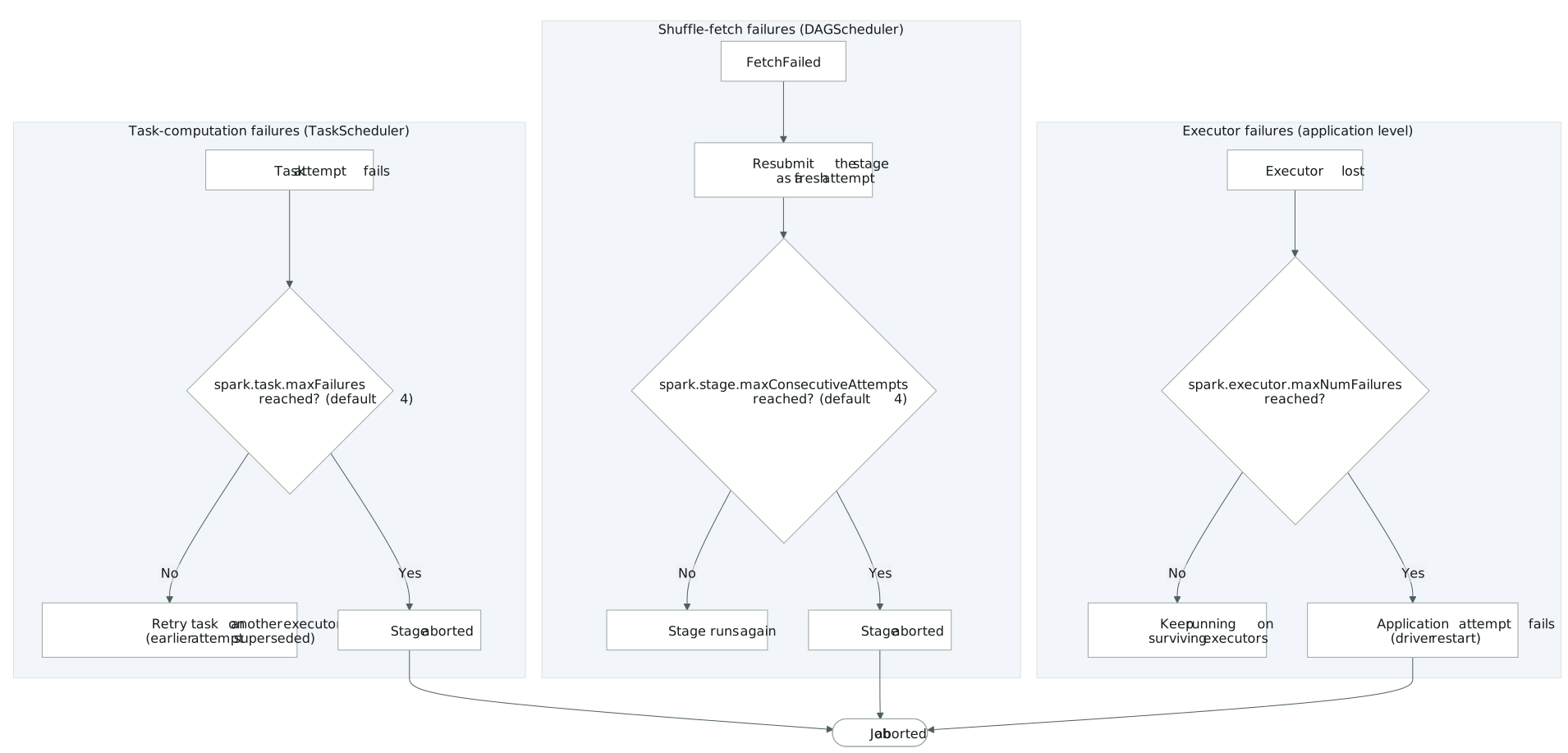
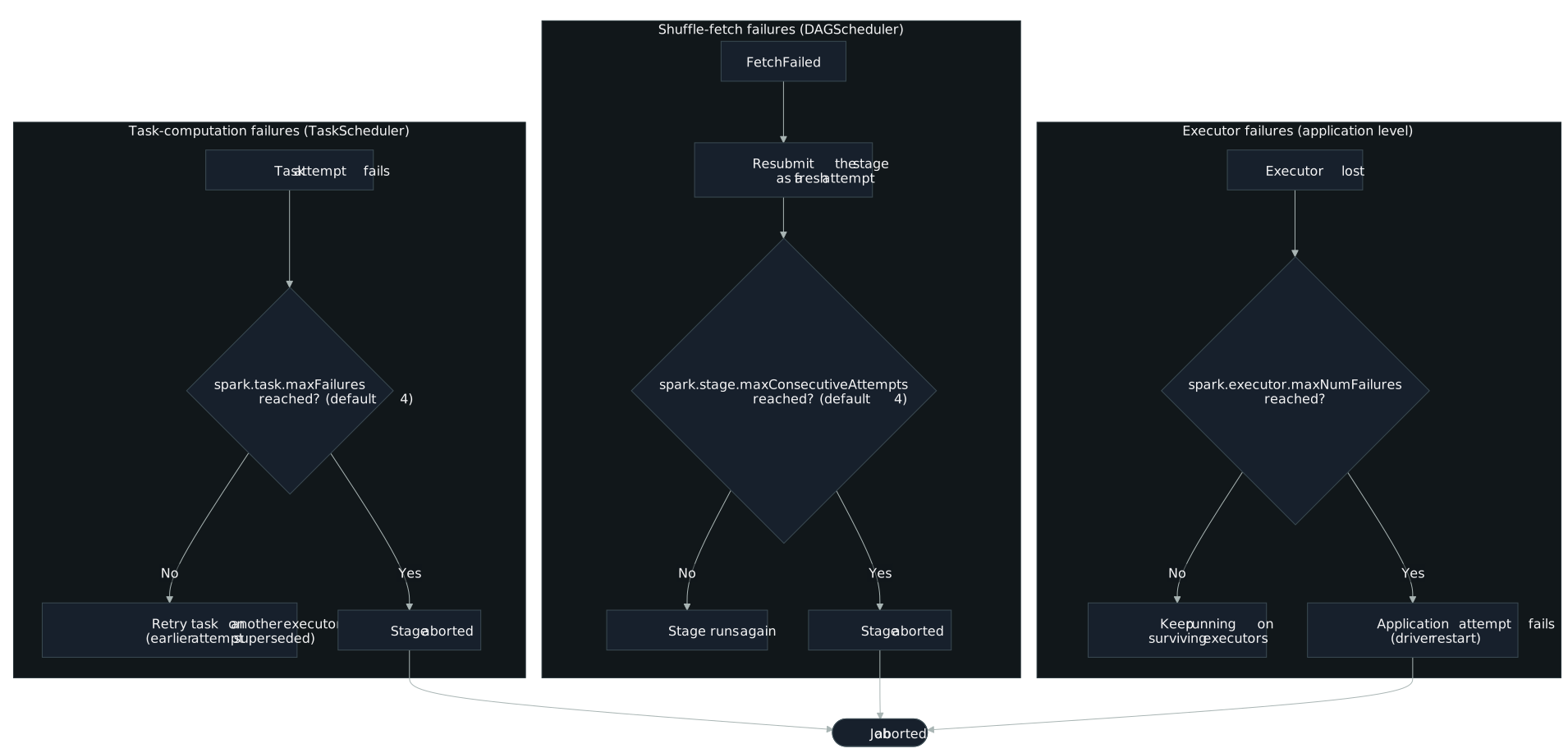
That budget is spark.stage.maxConsecutiveAttempts, default 4: the number of consecutive stage attempts allowed before the stage is aborted[5]. Fail, resubmit, and complete within those attempts and the job stays alive; keep failing until the limit is spent and the job aborts.
A FetchFailed is the classic trigger. It counts against that stage attempt limit, which is why spark.stage.ignoreDecommissionFetchFailure (default true since 3.4.0) exists: it keeps a fetch failure caused by an executor being decommissioned from counting toward spark.stage.maxConsecutiveAttempts, which by implication means ordinary fetch failures otherwise do count toward the abort budget[5:1].
Executor exclusion is the other stage-level lever. The spark.excludeOnFailure.* family is off by default (spark.excludeOnFailure.enabled is false) and tracks how many tasks must fail on one executor within a stage before that executor is excluded for the stage; it can also kill executors excluded on a fetch failure[5:2]. If exclusion leaves a TaskSet with no schedulable executor left, spark.scheduler.excludeOnFailure.unschedulableTaskSetTimeout (default 120s) caps how long Spark waits to acquire a new executor before aborting that TaskSet[5:3].
Confidence
The failed-task-share thresholds and the stage-failure behaviour both map to documented Spark scheduler mechanics; no branch here is experimental.
Limitations / false-positive risk
A high failed-task share is a blunt signal. It can be dominated by one systemic cause, such as a single lost executor whose tasks all fail at once, rather than many independent failures pointing at a code or data problem. Transient failures that a later attempt retries and succeeds are also not always harmful: task retries reset their count on success, so a job can carry a nonzero failure share and still finish correctly. Read the Reason distribution before treating the share as a defect.
Related
- Executor sizing: Cluster Tuning
- Memory overhead & off-heap: Memory Management