
Appearance
Broadcast Sizing
BROADCASTSIZING
What it is
A join has two ways to move data. The shuffle join forces all-to-all traffic across the cluster; the broadcast join ships one side out to every executor and skips the shuffle entirely. spark.sql.autoBroadcastJoinThreshold is the size gate that picks between them: it sets the largest table, in bytes, that Spark will broadcast when planning a join, and it defaults to 10 MB.[1][2] Set it to -1 and automatic broadcasting is off, so Spark always shuffles.[1:1]
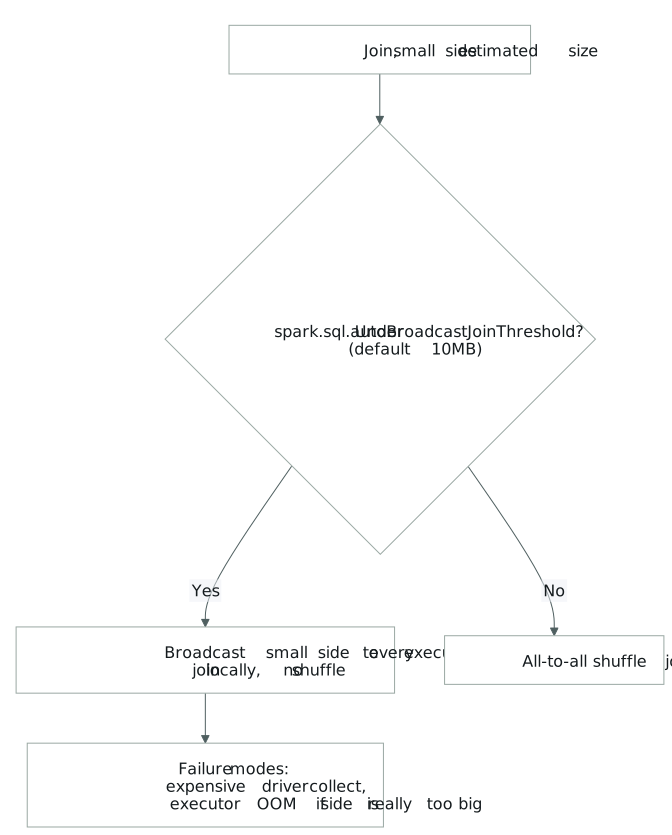
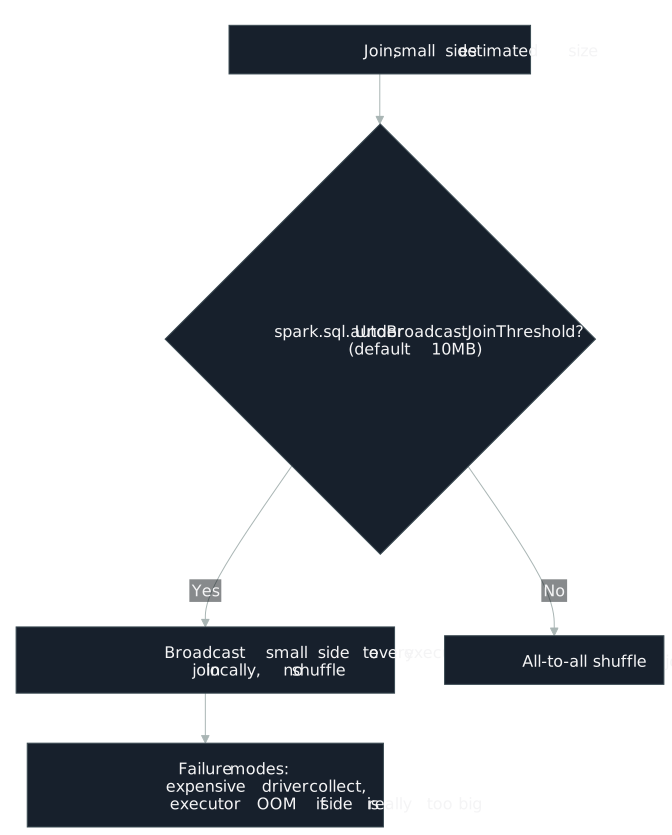
Given a join's estimated table sizes and that gate, there are two ways the choice can go wrong:
- underBroadcast: one side is small enough to broadcast but is being shuffled anyway. The join pays for an all-to-all exchange it could have avoided.
- overBroadcast: a side that is too large is being broadcast, which risks running the driver or the executors out of memory.
How it's detected
Each join carries an estimated size for the side in question, which is compared against the broadcast threshold:
| Finding | Condition | What it means |
|---|---|---|
underBroadcast | small side is being shuffled instead of broadcast | a cheap broadcast join was left on the table |
overBroadcast | an oversized side is being broadcast | the broadcast is a memory hazard |
Why it matters
Broadcasting the small side sends a full copy of that table to every executor. It pays off only when network bandwidth and executor memory are not the bottleneck; there, it is far cheaper than the shuffle it replaces.[3] That is the cost an underBroadcast finding is pointing at: a small dimension going through an all-to-all exchange when a copy on each executor would have run fast.
overBroadcast is the opposite mistake, and it fails hard. Pushing a table that is too large through the broadcast path breaks in two ways: too-large task result errors and out-of-memory failures, both because the oversized table has to be collected on the driver and shipped whole to every executor.[4] The size gate exists for exactly this reason: a copy on every executor is harmless for a small table and a memory hazard for a large one.
How to fix it
For underBroadcast, let the small side broadcast. If its estimated size sits above the 10 MB default but still fits comfortably in executor memory, raise spark.sql.autoBroadcastJoinThreshold to cover it, or force the strategy with broadcast(df) on the small side.[1:2][5]
For overBroadcast, keep the large side out of the broadcast path. Lower the threshold so the oversized table no longer qualifies, or drop the explicit broadcast() hint if one is forcing it, and let Spark fall back to a shuffle join.
Confidence
Validated for both branches. underBroadcast and overBroadcast rest on the same well-documented mechanism: the broadcast threshold and its two failure modes are standard Spark behavior, so neither branch is experimental.
Limitations / false-positive risk
The comparison is only as good as the size estimate behind it. Table sizes come from statistics that may be stale or missing, so a join that looks mis-sized can be measuring the wrong number. A large broadcast can also be deliberate: an operator who has sized executor memory for it may broadcast a table well past the default on purpose.
Performance Tuning (Spark SQL, DataFrames and Datasets Guide) ↩︎
Learning Spark, 2nd Edition, Damji, Wenig, Das, Lee, ch. 7 ↩︎
High Performance Spark, 2nd Edition, Karau, Polak & Warren, ch. 6 ↩︎