
Appearance
Job Failure Rate
FAIL-RATE
What it is
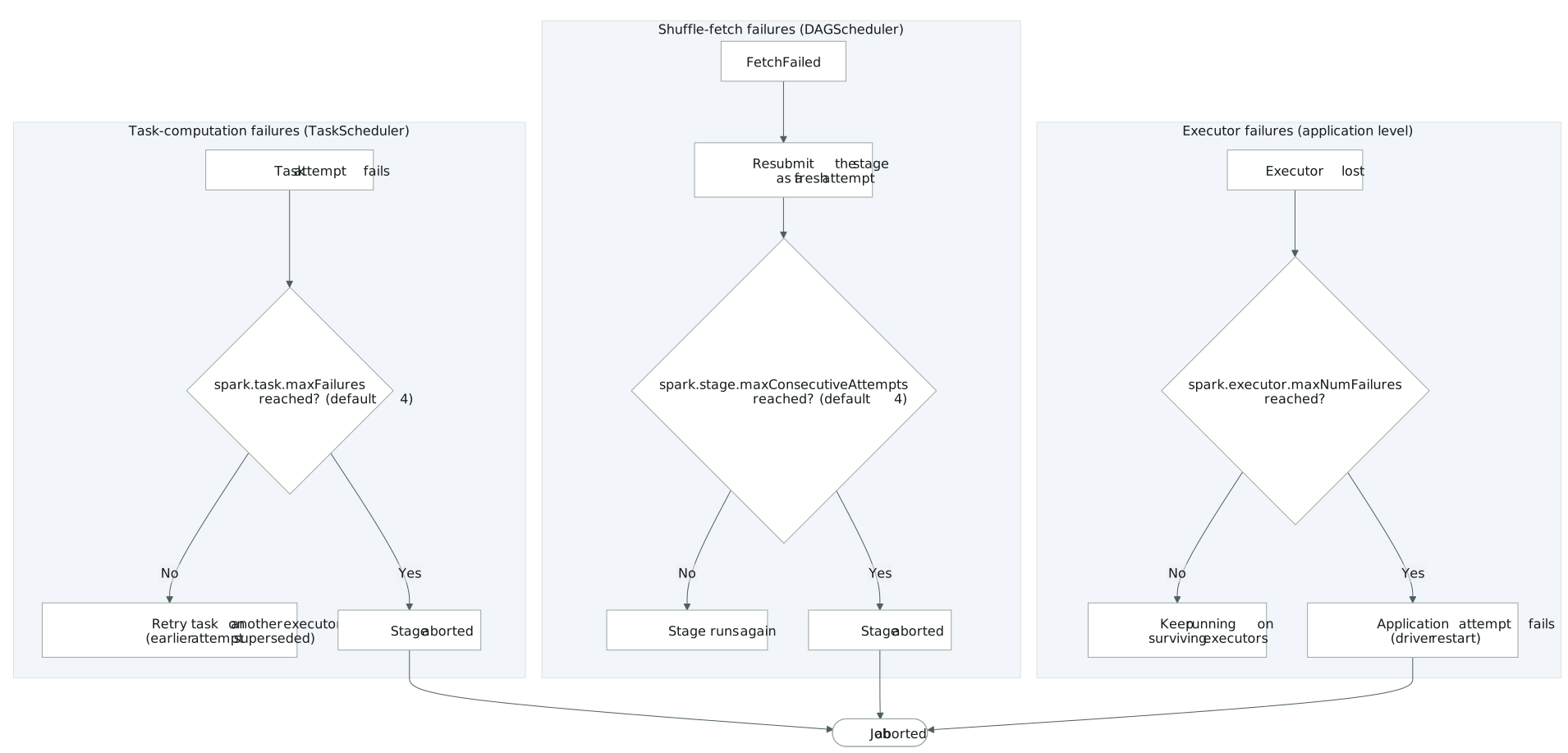
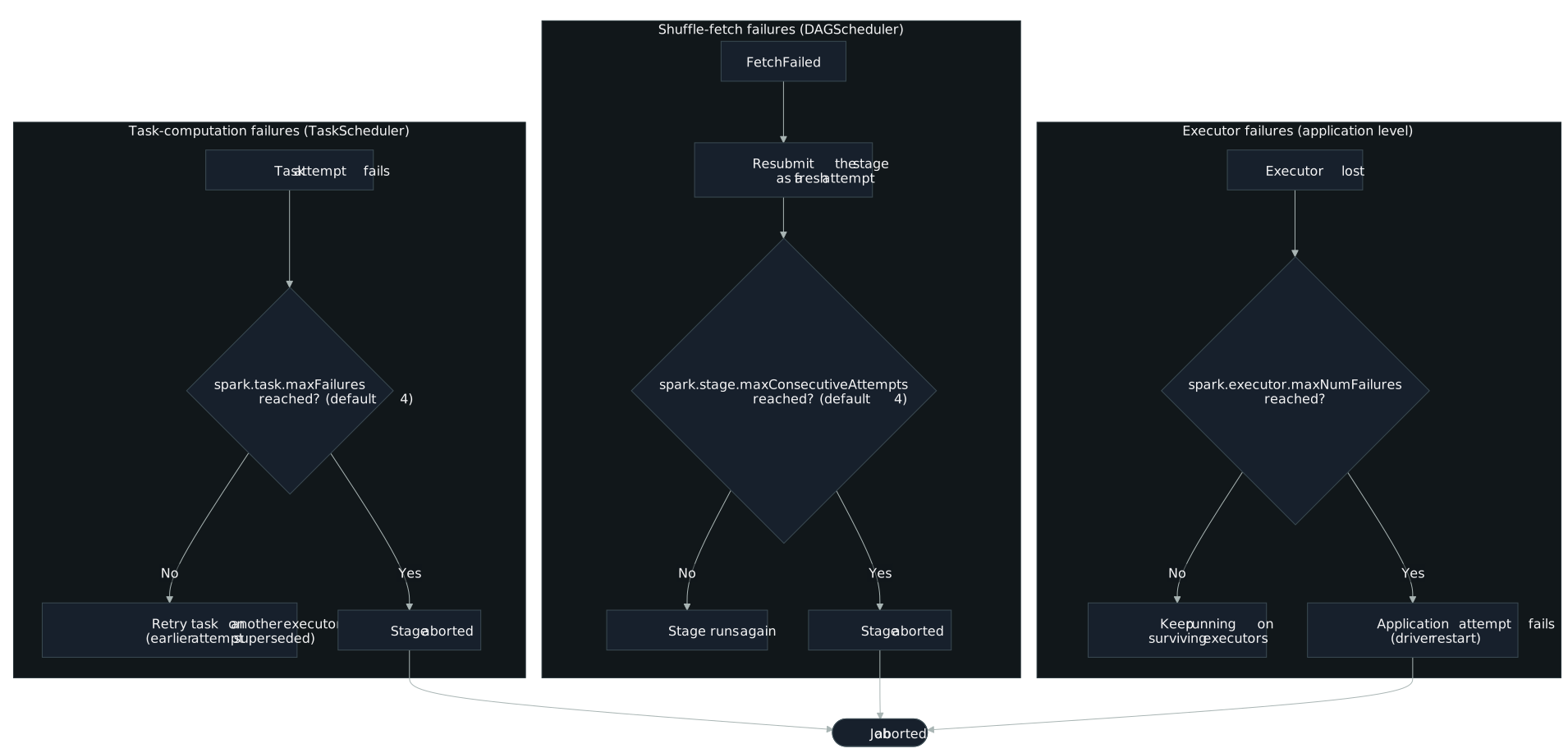
Not every task retry threatens the job. spark.task.maxFailures (default 4) counts "continuous failures of any particular task before giving up on the job. The total number of failures spread across different tasks will not cause the job to fail; a particular task has to fail this number of attempts continuously. If any attempt succeeds, the failure count for the task will be reset"[1]. A task that fails once and then succeeds on retry resets its counter and never counts toward job abandonment: that's a transient retry, and by itself it's harmless. Whole-job abandonment is a different, layered escalation above that: it only happens once an unbroken run of failures on the same task reaches the configured limit (3 retries allowed by default, since allowed retries = value − 1), or once higher-level retry budgets above the task level are themselves exhausted.
How it's detected
The layers above task-level retries are what turn isolated failures into a failed job. At the stage level, spark.stage.maxConsecutiveAttempts (default 4) bounds "the number of consecutive stage attempts allowed before a stage is aborted"[1:1]. By default, spark.stage.ignoreDecommissionFetchFailure (true, since 3.4.0) excludes fetch failures caused by graceful executor decommission from counting toward that limit, so a decommission-triggered FetchFailed doesn't push a stage toward abortion the way a genuine repeated fetch failure would[1:2]. On YARN and Kubernetes there's a further application-level ceiling: spark.executor.maxNumFailures (default numExecutors * 2, minimum 3, since 3.5.0) is "the maximum number of executor failures before failing the application," while spark.executor.failuresValidityInterval (since 3.5.0) lets failures spaced far enough apart be "considered independent and not accumulate towards the attempt count"[1:3]. The TaskScheduler owns retries at the task level, but it is "the DAGScheduler that ultimately declares the job to have failed"[2] once those retry budgets are exhausted, and because "a Spark job corresponds to one action" with a fixed DAG once that action is called[3], an aborted stage cascades directly into failure of the job built on it.
Why it matters
A rising failure rate that traces back to exhausted retry budgets, rather than to a single one-off task failure, points at a systemic problem (an unstable executor, a genuinely broken fetch path, or a resource ceiling being hit repeatedly) since none of these budgets trip on a single transient hiccup. Job-level failure is also distinct from application-attempt failure: on YARN, "each application may have multiple attempts," and the history server displays failed attempts alongside "any ongoing incomplete attempt or the final successful attempt"[4]: a separate, higher layer of retry (driver/application restart) above the in-job task and stage retries covered here.
How to fix it
- Check which budget was exhausted before treating a job failure as a single root cause: a single task failing
spark.task.maxFailurestimes consecutively, a stage being resubmitted untilspark.stage.maxConsecutiveAttemptsis reached and aborted, or (on YARN/Kubernetes) cumulative distinct executor failures exceedingspark.executor.maxNumFailures[1:4] each point at a different underlying problem. - If failures are decommission-triggered
FetchFaileds during a normal scale-down, confirmspark.stage.ignoreDecommissionFetchFailureis enabled (defaulttruesince 3.4.0) so they aren't inflating the stage-abort count[1:5]. - On YARN/Kubernetes, if unrelated executor failures spread far apart in time are tripping
spark.executor.maxNumFailures,spark.executor.failuresValidityInterval(since 3.5.0) can let sufficiently-spaced failures stop accumulating toward the same count[1:6]. - See also retry waste: the same executor-loss and
FetchFailedcauses that eventually exhaust these budgets and fail a job are, below that threshold, also the source of wasted executor time on jobs that ultimately succeed.
PySpark: these are session-level configs, settable without a
spark-submitflag:spark.conf.set("spark.task.maxFailures", "4"), and the stage/executor-level equivalents the same way.
The retry-budget ladder: defaults shown; raise a budget only once you know which layer is tripping:
properties
# Task level: consecutive failures of one task before the job is abandoned (default 4 => 3 retries)
spark.task.maxFailures=4

# Stage level: consecutive stage attempts before the stage is aborted (default 4)
spark.stage.maxConsecutiveAttempts=4

# Don't count graceful-decommission fetch failures toward the stage-abort limit (default true since Spark 3.4)
spark.stage.ignoreDecommissionFetchFailure=true
Limitations / false-positive risk
A nonzero job-failure rate can be dominated by a single repeatedly-failing job rather than a systemic issue, so the rate alone doesn't tell you whether the problem is broad or isolated. Retried jobs that eventually succeed still count toward attempts, which can inflate the rate above what the eventual outcomes justify.
Related
- Retry budgets & executor stability: Cluster Tuning
- Avoiding the failures upstream: Anti-Patterns
High Performance Spark, 2nd Edition, Karau, Polak & Warren, ch. 2 ↩︎